Originally published on 4/1/26
As conversations surrounding immigration continue, many Americans have had their eyes on one topic in particular: birthright citizenship, a term created by the constitution that’s currently under discussion in Washington, D.C. and beyond. But what exactly is birthright citizenship? And why are lawmakers and Americans so concerned about it right now? We share everything you need to know below.
What is birthright citizenship?
Birthright citizenship is the principle that anyone born in the United States automatically becomes a U.S. citizen, regardless of their parents’ citizenship status, immigration status or nationality.
Congress established this right in 1868 as part of the 14th Amendment to the Constitution. Originally, lawmakers created it to protect the citizenship of recently freed slaves and their children, but in more recent years, this constitutional protection has been used by immigrants who have come to this country in the hopes of creating a new and better life for themselves and their families.
“All persons born or naturalized in the United States, and subject to the jurisdiction thereof, are citizens of the United States and of the State wherein they reside,” reads the rule.

Currently, about three dozen countries around the world offer birthright citizenship. This is a large decrease compared to the start of the 2000s, and comes after countries including Ireland, The United Kingdom, Australia and New Zealand abolished the rule within their own countries.
“It’s a rule of nonracial citizenship. It doesn’t matter who your parents are—being born in the United States makes you an American citizen,” Harvard Law School Professor Gerald Neuman said in an interview with Harvard Law Today. “One disadvantage is that it could be overbroad in providing protection to some who will turn out not to need it. In other words, not everybody who’s born in the United States spends the rest of their life in the United States. But they have the option to give up their citizenship.”
Why is birthright citizenship in the news?
In recent years, the term birthright citizenship has garnered a lot of heat from lawmakers. President Donald Trump even weighed in on the issue back in January 2025, when he signed an executive order aimed at banning birthright citizenship. In his order, the president claimed that the clause was outdated and was being abused by families.
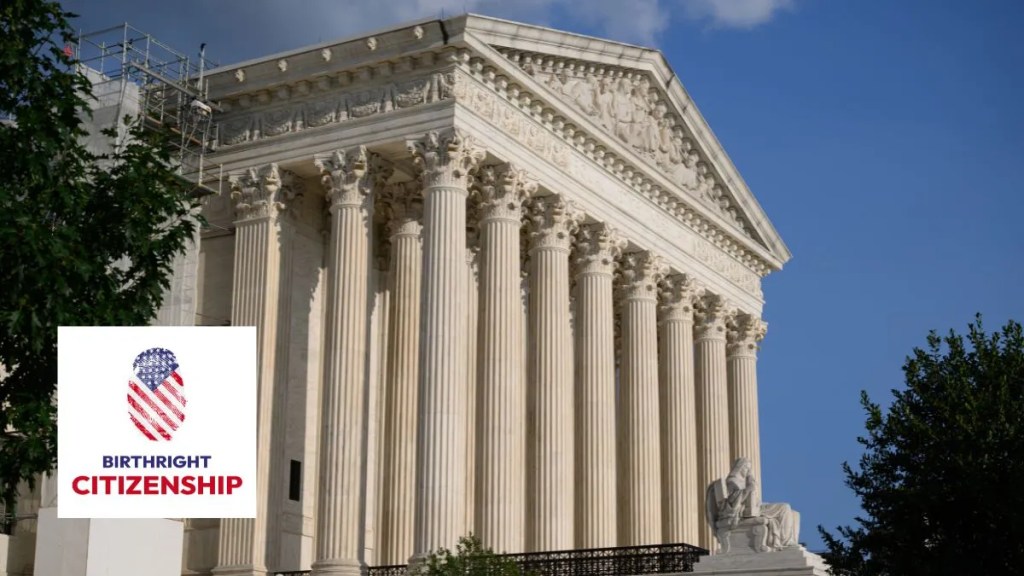
The order was met with heavy pushback and even made its way to the Supreme Court, which is expected to weigh in on the issue later today.
“This is something that is fundamental to our country, is that we were built on immigrants,” Kathleen Otal, an American citizen who was seen protesting outside the Supreme Court earlier today, told NBC News. “People who were born here are true Americans, and they always will be and we’re not willing to give that up.”
President Trump is expected to appear at the Supreme Court hearings today to voice his concerns on the issue. His appearance will make him the first ever sitting president to attend a Supreme Court hearing.
“If President Trump wishes to come to the Supreme Court to watch the ACLU [American Civil Liberties Union] school him in the meaning of the Constitution and birthright citizenship, we will be glad to sit alongside him in that very court,” ACLU executive director Anthony D. Romero told the news outlet. “The Supreme Court is up to the task of interpreting and defending the Constitution even under the glare of a sitting president a couple dozen feet away from them. [It’s] one of the most important cases in the last hundred years.”
Can the United States actually ban birthright citizenship?
Despite President Trump’s executive order, Neuman said, “The president has no authority to change the citizenship rule at all. Congress can change the rule, but only to the extent of making it broader. Neither Congress nor the president can reduce it below the constitutional minimum.”
He did not weigh in on what could happen if the Supreme Court decided to side with President Trump. As of publication, there is no news on which way the highest court in the land is leaning.

“This is fundamental,” Mary Wertsch, another protester stationed outside the Supreme Court building, told NBC News. “I can’t believe the court even is looking at it. It could not be clearer in the Constitution, this is essential.”
What this means for Americans
If you’re wondering how this debate might affect you or your family, here’s what to know: Right now, birthright citizenship remains legal, and anyone born in the United States is a U.S. citizen. The Supreme Court’s upcoming decision will determine whether the executive order can move forward, but any changes would likely face additional legal challenges and would not affect anyone who already holds U.S. citizenship.
If you or someone you know has questions about citizenship status, visit the U.S. Citizenship and Immigration Services (USCIS) website at uscis.gov.
Link to original: https://www.womansworld.com/life/what-is-birthright-citizenship-experts-explain-the-debate




 Carissa Mosness
Leave a comment