Originally published on 6/17/25
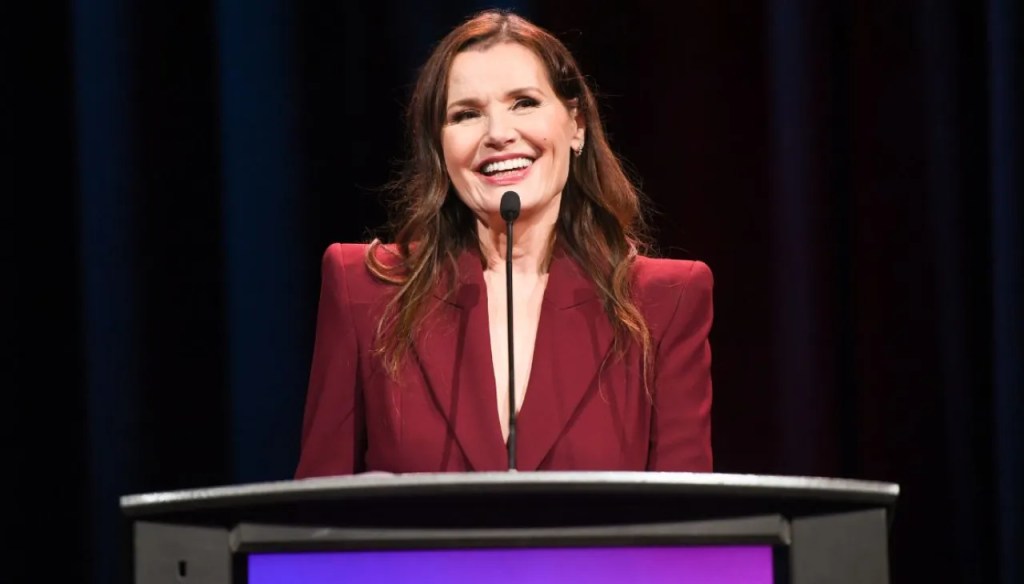
We all know and love Geena Davis, 69, an Oscar-winning actress whose legendary film career includes such classics as Thelma & Louise (1991), A League of Their Own (1992) and Beetlejuice (1988). These Geena Davis movies are iconic not just for their stories, but for their empowering female leads — something that inspired Davis to launch her nonprofit, the Geena Davis Institute on Gender in Media. Recently, the GDI teamed up with the Coalition of Asian Pacifics in Entertainment (CAPE) to re-release a study they conducted in 2021, which centers on Asian Pacific Islander (API) representation in Hollywood. Woman’s World recently sat down with Davis to discuss this study, as well as her decades-spanning career in Hollywood.
How Geena Davis became a leading voice for women in Hollywood
According to a study released by the Geena Davis Institute and CAPE, 62% of API workers believe their voice is heard and valued, representing a significant increase from the 44% reported in 2021.
“We love working with the Geena Davis Institute and its team. They’re aligned with the work that we both do, and just to team up together is very special,” Michelle Sugihara, Executive Director and CEO of CAPE, said to Woman’s World.
Davis herself founded the nonprofit back in 2004, and she now serves as the chairperson.
“As a working actor, prior to having children, I was fortunate to be offered strong female leads and to work with filmmakers who valued stories about substantive women characters. What I didn’t realize, until I had kids, was the lack of balance in on-screen representation. When I sat down to watch children’s television with my daughter, I was struck by the fact that so few of the characters we would see on screen were cast as female.”

“Women are 50% of the population but that wasn’t reflected in the programming I was viewing. I shared my concerns with industry executives and creators, and they all said, ‘No, that’s not true, not anymore.’ Nobody was deliberately excluding women, but the go-to for casting extras and supporting roles was always men. I knew that I would need indisputable data to prove the disparity that existed. That’s how the Geena Davis Institute on Gender in Media, now the Geena Davis Institute, was born,” the actress said.
Last year, the organization celebrated its 20th anniversary. “As the institute has evolved, we’ve expanded our mission and now advocate for equitable on-screen representation for six identities: gender, race/ethnicity, LGBTQIA+, age, disability and body type,” Davis added.
Geena Davis on her most iconic roles
Aside from her advocacy work, Davis is also an actress known to many from either the 1991 thriller Thelma & Louise or her 1992 historical fiction film A League of Their Own. According to the actress, those two films are a significant part of the reason she is who she is today.

“A League of Their Own, which was based on a true story about a women’s softball team in the 40s, celebrates excellence in women’s sports,” Davis said. “GDI proudly supports women athletes; we amplify their successes and share their stories on social media and in our must-see newsletter. So many girls have been inspired by the movie and the real-life players it portrays, which just proves our point that ‘If they can see it, they can be it.’”
Why Susan Sarandon’s confidence was a turning point
Davis also shared that “Meeting Susan Sarandon on the set of Thelma & Louise was “eye-opening for me.”
“Up until that point, I just tried to get along and not make waves. Susan, on the other hand, stood up for herself. If she didn’t like a line of dialogue, she changed it. Seeing that, I felt more confident about advocating for myself. And then so many women who saw the movie felt seen for the first time,” she continued.

“The impact that Thelma and Louise had really showed that women viewers had been waiting for characters that made them feel empowered, and knowing I had been a part of that was empowering for me. Becoming an advocate for equitable on-screen representation became a natural progression.”
Since those two films, Davis has gone on to star in several other high-profile projects, such as Cutthroat Island (1995), Long Kiss Goodnight (1996), Stuart Little (1999), Grey’s Anatomy (2014 to 2018), Marjorie Prime (2017) and Blink Twice (2024). She has also become a very sought-after executive producer.
 Carissa Mosness
Leave a comment