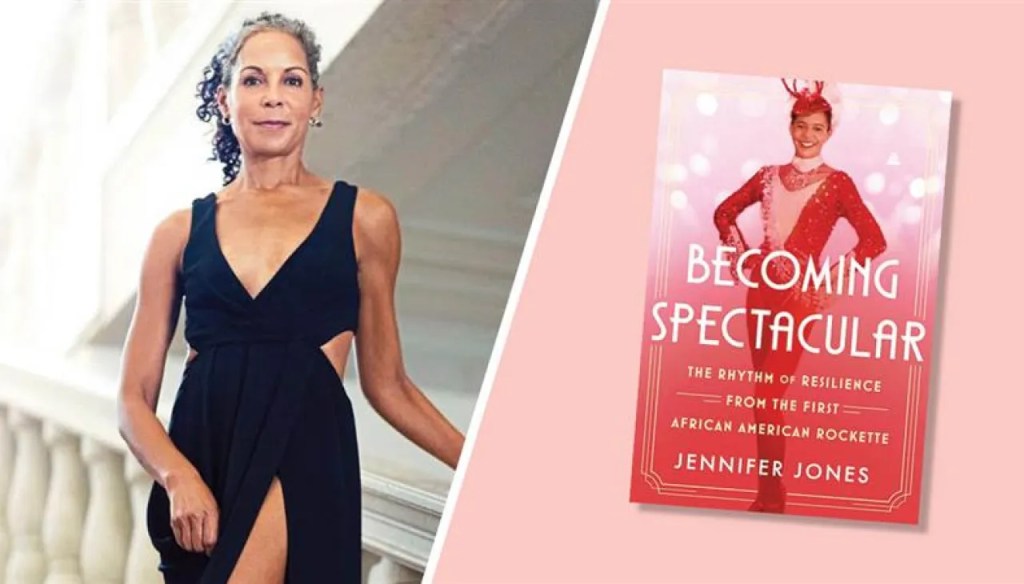
Originally published on 2/11/25
Jennifer Jones, 57, made history by becoming America’s first-ever African American Rockette in 1987. Since then, she has gone on to release a doll, a children’s book and even a memoir entitled Becoming Spectacular: The Rhythm of Resilience from the First African American Rockette. Woman’s World recently sat down with Jones to not only discuss her new book but also to find out how her time with The Rockettes really was and how she is doing after her recent colorectal cancer scare. Keep scrolling for more.
Woman’s World: Congratulations on Becoming Spectacular! What was the creation of this book like, and what do you hope people get out of it?

Jennifer Jones: The creation of this book has been a journey ever since my 40s. I picked up the pen and paper a million times to write my story of becoming the first Black Rockette, but every time, something more important came and took my attention away from it.
I always intended to write this book, so when the universe brought the right people to me, and it was the right time, I had time to sit down and think about what I wanted to say. And I had so much more to offer in this book than I ever thought imaginable.
I hope it resonates with people and that they can apply it to their lives. Everybody’s life has a story; there’s always a golden nugget and something to learn. So, I hope they can reflect on their lives and share that with their family, children, grandchildren, friends and the world.
WW: You also released a children’s book, On the Line: My Story of Becoming the First African American Rockette, in 2023. How different was it to write a biography as opposed to a children’s book?

JJ: It was the first book I’ve written, and I had help from the great Lissette Norman [the co-author], who helped me get a children’s perspective on how they would view a story. But in the children’s book, I learned a lot about how to write, what children look for and how to inspire kids even more through pictures and words.
The memoir was more therapeutic. I really had to go back in the past and relive some of those hurtful memories. That was the hardest part for me, but it was also remembering the joyful ones, reflecting on that, and really seeing what I have done for the Black women who are currently Rockettes and the ones who will audition and become one. And also my cancer journey, something that I’ve never thought that I would say, but I’m hoping people can get through that as well and raise awareness for colorectal cancer awareness.
WW: Let’s rewind a little bit. What was the audition process like for The Rockettes back in the 1980s, and what made you want to go out for it in the first place?
JJ: The audition process is much different from the way it is today. Back in the 1980s, there wasn’t any social media, Google search engines or anything like that, so I didn’t really know who The Rockettes were. My dream was to be a Broadway star. My parents were big Broadway goers. One day, we were going through Backstage [magazine] looking for auditions that week, and the Rockettes came up. My mom said, “Jennifer, you would make a perfect Rockette.” I was like, “I don’t know what they do.”
On the morning of, I decided, “What do I have to lose?” I got to the music hall, where a line of women wrapped around me, and I thought about leaving numerous times. I didn’t see another Black woman on the line; everyone had to do their hair, makeup and clothes. But, I had an inner voice that said to stay, and I did.
So, when I got to the audition, I realized I was unprepared. I did not have my tap shoes. I did not have a picture and resume. So when I got through the height requirement, we were shown two dances. They were casting for two shows, the Super Bowl Halftime Show and the Chita Rivera tour. I went to gather my things at the back of the music hall, and the stage manager came up to me and said, “Jennifer, we’re going to give you a callback. Bring your tap shoes and bring your picture and resume.” I was living in New York at the time. I returned to New Jersey, found an old high school headshot and made a resume. I went to Kinko’s [photocopy store], got it printed, and then I went back to the audition, and had my call back, which was successful. A few months later, I got a call and was asked to do the Super Bowl halftime show with Chubby Checker.
WW: What was your favorite thing about being a Rockette, and is there anything you wish to change?

JJ: I loved so many things about being a Rockette. Oh, my goodness, I wouldn’t even know where to start. I loved the costumes. I loved being fitted for the costumes; we had in-house seamstresses at the time. I loved walking into the large rehearsal hall. I loved dancing on that stage. I loved doing the Macy’s Day Parade. I got to do Comic Relief with Whoopi Goldberg, Billy Crystal and Robin Williams. I got to go on tour with Susan Anton and Maurice Hines, Joe Lee. I could go on and on and on about all the experiences that I loved. And no, I wouldn’t change a thing. I think everything was laid out beautifully and the way it was supposed to be done, and I loved every second of it.
WW: The world is currently facing a lot of adversity and changes that are quite scary for many people. How do you think your book and The Rockettes can help women and people of color in terms of safety, community and understanding?
JJ: Yes, the world is definitely changing at a rapid pace. I can’t speak for The Rockettes and what they can do, but I can speak for what me and what my book can do. In my book, I lay out experiences that happened to me when DEI [Diversity, Equity and Inclusion] programs were not around. Still, we did have the NAACP [the National Association for the Advancement of Colored People] who were fighting for Black people and people of color.
WW: With that in mind, what are your feelings about the changes currently being made with DEI?
JJ: I feel like the DEI programs helped so many more people, not just the Black and brown people, but [also] women’s movements, faith-based spiritual movements, people with mental disorders such as ADHD and autism, And they help our veterans and seniors. They help so many people, and I think it’s very harsh to pull out of what’s happening.
I think it’s going to affect a lot more people than even certain people who think that it only affects brown and Black people. Hopefully my book, and me being Black and the first Black Rockette, can shed some light on what we all can do as a community. I hope that it can spread awareness of things that I went through and persevered through, and hopefully, as a community, we can all come together and push together and still move forward.
WW: You mentioned a love of Broadway. What would you say is your favorite show?
JJ: The Wiz changed my life. It really changed my life to see Black actors like Stephanie Mills, Mabel King and André De Shields up on that stage. And then waiting for autographs at the backstage door, and not knowing as a little girl how that would happen. That changed my life, and I have to thank my parents for taking me to see that show.
WW: Let’s talk more about your colon cancer journey. What was that really like?

JJ: My cancer journey was very much a surprise. When I was first diagnosed, I was very ashamed and embarrassed, and I didn’t tell my family and friends for a month.
Part of my journey was the care of my team that I had. I had an almost all-female oncology and surgical team, and they made it a safe haven for me. They also taught me how to talk about it. And when I was going through chemotherapy, I did a lot of research on what I could do on the other side of my surgery and afterward. I felt like it was a stronger calling for me to talk about it, and I feel empowered by it; I feel like I’m changing lives by it.
I feel like I’m making a difference in the world, not only in the younger generations but also in the African American community, which hits very hard because they don’t have the resources, they don’t really have the trust in the health care system and they don’t have the open conversations, as we all don’t about our family history or what’s happening in our bodies, so I’m hoping I can bridge together conversations in a more comfortable atmosphere.
I am now six years cancer-free!
WW: Which is incredible! So, how has life looked for you since leaving Radio City Music Hall, and what are you looking forward to doing in the coming years?
JJ: After I left Radio City, I was able to perform on Broadway, which was my dream. I was in 42nd Street: The Musical, and we won a Tony for Best Musical for a revival. So I’m very thankful for that.
Now, I’m really enjoying having my work out in the world for people to enjoy. I have my Dancing Jennifer Doll, which I’ve designed, and that’s available on Amazon and Walmart. I’m remarried, so I’m enjoying time with my husband. My children are grown, healthy and flourishing, and I couldn’t be happier in the world at large.
Link to original: https://www.womansworld.com/entertainment/celebrities/jennifer-jones-on-being-the-first-black-rockette-her-memoir
 Carissa Mosness
Leave a comment